

Paul McCartney x McDonald's
A night in Montreal with two 80-year-old global brands

Dear Crunchwrap Nation,
Happy (very belated) new year from Crunchwrap HQ! I am (still) writing you from Montreal, where I am mispronouncing basic French words and hiding my highly valuable beef tallow reserves from the U.S. government.
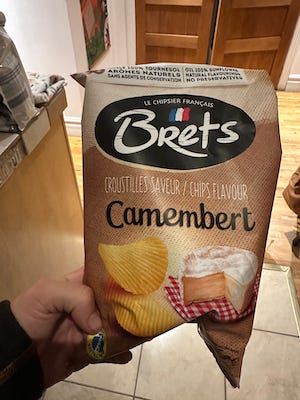
In all seriousness, I really like it here and will be sad to leave next week. There’s a lot to respect about the Québécois lifestyle, including the market’s commitment to producing some of the world’s most sophisticated stoner food.
In this Crunchwrap, I’m sharing a few good links and thinking a little too hard about what Paul McCartney and the Golden Arches have in common.
BUT FIRST…if you’re a new subscriber (hey), here’s a bit about this newsletter:
I’m Adam Chandler, a journalist (usually) based in New York who writes for a bunch of places about culture, work/labor, fast food, regular-speed food, business, Americana, and more. I’m also the author of two books, Drive-Thru Dreams and 99% Perspiration which, in spite of some really bad Columbus jokes, came out last year to wide acclaim. (I occasionally do some unwieldy hand-talking on The History Channel’s The Food That Built America and other programs.)
In this newsletter, I cover Critical National Issues like waning social cohesion in America, Taco Bell (obviously), and the cultural endurance of Billy Joel. I welcome responses and gripes. If you’d like to support me, please check out my new book and forward this newsletter to an ex you might still have feelings for.
Le Big Macs
Beyond their ancestral Scottish name-origins, mining thematic links between Paul McCartney and McDonald’s is an unnatural proposition. Paul McCartney is a menschy vegetarian who has collected every creative and societal honorific, including knighthood for his good works; McDonald’s is the world’s largest purchaser of beef and pork, has been censured by basically every labor and animal rights group, and was regularly served as a reward to cooperative detainees at Guantanamo Bay.
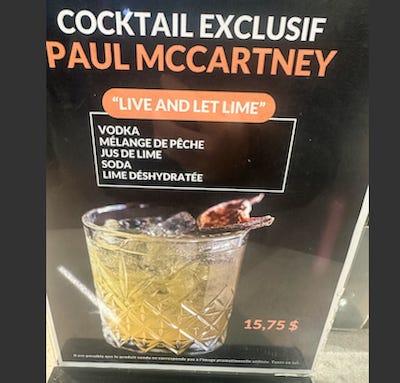
But look, I love them both and in either case, you don’t become a successful global brand without stoking some crowd-pleasing mass appeal. And so, when Sir Paul made Montreal a stop on his most recent tour, The Crunchwrap trekked downtown for the show. On my way there, I remembered that I hadn’t made a stop at a Canadian McDonald’s on this trip yet and so I decided to double up on the Macs.
Warm, Harmless Brands
Though zealously loved by their own broad fan bases, McDonald’s and Paul McCartney both resemble cultural muzak – something that generally exists inoffensively in the background at this point. In other words, people tend to know who/what they are and what they’re generally about. Neither is likely to surprise you by doing something unexpected or controversial.
This is important because people tend to crave the safe and familiar in tumultuous times – cherished cultural artifacts, comfort foods – and part of what appeals about a Big Mac dinner or a Paul McCartney show is that they are predictable experiences without the complications of expectation. They’re neither cool nor countercultural. At worst, we’re talking simple, earnest, inter-generational fun; at best, something a bit more special.
Families Served
Obviously, anything offering apolitical predictability and simplicity will beckon the family unit. Writing of the early days of the chain in his book The Fifties, the legendary David Halberstam explained how by getting rid of female carhops and their young male pursuers, the McDonalds’ brothers primed its business for a whole new demographic (American families) just as the post-war financial and baby booms were taking off in the United States:
By 1950, the teenagers had departed to more tolerant hangouts and were replaced by working-class families, who, thanks to the McDonalds’ low prices could afford to feed their families restaurant meals for the first time. The kitchen was enclosed by glass and children liked watching the burgers cooking on the stainless-steel grills. The children were seen as important from the beginning and the word was put out that the staff was to be very nice to the kids because kids came equipped with parents.
Sir Paul understands this too. The show had a lot of levity and comedy, synchronized dancing from the backing band and some slapstick antics from his tour drummer Abe Laboriel Jr. AND…despite endless political things to say about this heated moment, the feistiest that Paul McCartney got was in recounting how The Beatles integrated a segregated venue in Jacksonville in 1964 by threatening not to play. This was before he performed “Blackbird,” his civil rights tribute song, which was recently recast by Beyonce. All told, it was good, uncomplicated fun by design.
Glocalization
A more interesting bit of overlap in the McDonald’s-McCartney diagram (IMHO) is a simple act of taking local tastes into account. A few years ago, I wrote about the superiority of Canadian McDonald’s for Slate and one of the reasons they are great is the size and variety of their menu compared to American ones:
Take breakfast, for example, where there are more than twice as many options to devour by the dawn’s early light in Canada. That includes fried chicken sandwiches, which, despite having been invented in American kitchens, apparently have no place on the breakfast menu of our biggest national chain.
For my three loonies or whatever, Canada’s most infuriating breakfast offering is the Egg BLT McMuffin, which takes an American Egg McMuffin and zhuzhes it up with bacon, green-leaf lettuce, tomato, and a tangy mayo sauce. If the original American Egg McMuffin is famously a portable homage to eggs Benedict, then the Egg BLT McMuffin is Canada’s portable homage to eggs Benedict Arnold, a symbol of rebellion against American austerity. (Adding further insult is the presence of “processed cheddar,” an ingredient that Canadian outposts won’t even deign to acknowledge is very clearly American cheese.)
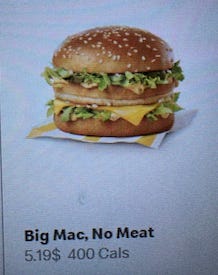
This business strategy is inelegantly called glocalization. Think of kosher or halal burgers at McDonald’s in the Middle East, gazpacho or macarons in Europe, spam and egg breakfast sandwiches in Asia. In Canada, glocalization translates to big breakfasts and other mind-boggling options:
BUT BUT BUT, glocalization also means poutine in Canada which is exactly the sloppy, perfect, wee-hours fare that fast-food dreams are made of, especially after a long night out at a bar or working a late shift.
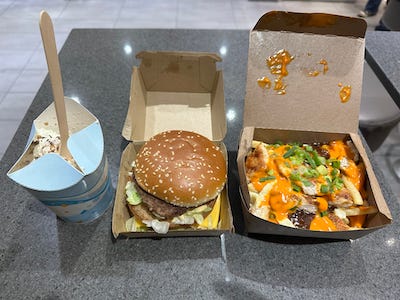
At the Montreal McDonald’s, I had three varieties of poutine to choose from – classic, bacon ranch, and buffalo chicken. Having overloaded on classic poutines, I went for the buffalo poutine and, quite honestly, it was MUCH better than I was expecting. Like impressively so. However, the highlight was a Skor McFlurry (sort of like a Heath bar), which you’d never get in the United States because (like McCartney), we only tend to play the hits in America. It was easily the best McFlurry I’ve had this side of a Caramel Biscoff McFlurry I had in the Netherlands.
Now, most arena acts – except for like Radiohead – also tend to perform this little feat of glocalization, even if it’s just the bare-bones minimum of screaming of HELLO ST. LOUIS! at the start of a show.

Paul McCartney being Paul McCartney, he didn’t just break out a little busted French for his show banter, but surprised the crowd by adding his lightweight Rubber Soul gem “Michelle” to the otherwise rigid and carefully orchestrated tour setlist.” The song, you may know, sports a little French in the lyrics along with some Gallic-inflected accordion. Needless to say, the crowd went nuts when this happened.
Was it the best rendition of the song you’ll ever hear? Absolutely not. But like the familiar crunch into the tempura of McNugget batter, it reminds one of simpler days. There’s something to that.
Good Links
I really loved this Adam Kirsch essay (gift link) for The Atlantic about how we’ve been trying to market reading for pleasure as a virtue and social good instead of tapping into its subversive power.
I’ve been obsessed with grocery chain Aldi as much as the cult of Aldi for years. Thankfully, friend of the Crunch Deena Shanker and Tim Loh did a DEEP DIVE into the aisles (gift link) on its history and operating model for Bloomberg Businessweek.
There’s plenty of bad news out there. Bryan Reisberg, who schleps adoptable shelter dogs around NYC to the delight of the dogs and the city is absolutely worth a follow on Instagram. The New York Times profiled him (gift link) this week.
That’s it for this week’s Crunchwrap! Thank you as always for reading, sharing, and writing in with nice recs.
In the coming days, I’ll be putting together my final poutine report from three months in Montreal, so be on the lookout for that.
With love,
Adam